



According to manufacturing processes, the development of automotive window films has gone through four stages: coating and composite processes, deep dyeing, vacuum evaporation plating, and magnetron sputtering.
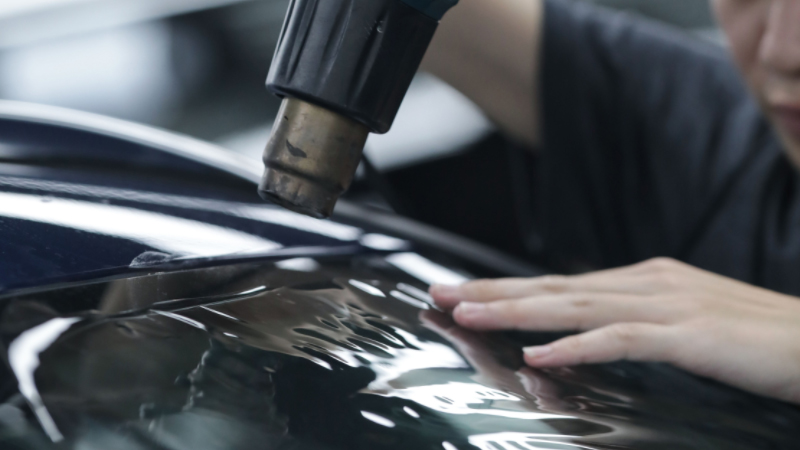
- Coating and composite process film: Due to the direct dissolution of pigments in the adhesive film by the coating and composite process, which does not contain a metal insulation layer and has poor perspective, it has been phased out.
- Deep dyeing refers to the process of penetrating PET through a dye pool, using a specific process to penetrate the dye deep into the PET substrate, and adding a heat absorbing agent to absorb infrared rays from sunlight, achieving thermal insulation effect. However, due to the simultaneous absorption of visible light, the transmittance of visible light is insufficient and the clarity is poor. In addition, when the heat absorbed by the heat absorbing adhesive reaches saturation, it will radiate the absorbed heat back into the car in a far-infrared manner, making people feel even drier and hotter. These two processes are currently widely used in the mid to low end automotive film market.
- Vacuum evaporation coating refers to the process of vaporizing the coating material under vacuum conditions by heating and evaporation, and the particles fly to the surface of the substrate to condense into a film. Due to the thin and dense coating material attached to the PET substrate, the film has good toughness and bending resistance, greatly improving its light barrier ability, and better insulation performance.
- Magnetron sputtering film is a relatively high-end automotive window film currently on the market, which evenly distributes metal materials onto PET substrate through magnetron sputtering technology, forming a nano metal layer. It has the advantages of high visible light transmittance and low internal reflection. Excellent magnetron sputtering solar films are made by sputtering up to 5 to 11 layers of precious metals. The more metal layers there are, the more expensive the price. Due to the mutual extinction of the metal layers, the reflectivity of automotive films significantly decreases. Generally, high-end magnetron sputtering films can reduce the internal reflection to less than 9%. Compared to vacuum evaporation plating, magnetron sputtering has a more uniform metal film thickness and better product consistency.
- Nano ceramic film refers to the production of infrared absorbing nanomaterials such as ATO (tin antimony oxide), cesium tungstate, and other raw materials into a thin film through coating composite, magnetron sputtering, or direct extrusion molding. These nanomaterials themselves can block infrared and ultraviolet radiation, serving as insulation coatings for some glass, and adding them to the film can further enhance the insulation effect.

The endothermic nano ceramic film is currently the most mainstream product in the automotive film market. At the manufacturing level, ATO and titanium dioxide are used to make coatings and add them to the PET film. The manufacturing process is relatively simple, and the raw material cost required for production is also relatively low. However, there are also process differences in the preparation of nano ceramic films, which are that the coating method after coating can use different processes, such as chemical solution deposition (CSD), chemical vapor deposition (CVD), magnetron sputtering, etc.
Nano ceramic films have the same basic properties as magnetron sputtering metal films in terms of insulation, transparency, and explosion-proof properties, but have more outstanding properties such as oxidation resistance and non blocking electromagnetic signals. Due to the material properties of nanoceramics, they do not gradually oxidize or fade over time, resulting in more stable and long-lasting insulation performance. The car film is also more durable and less prone to corrosion.
Selection of Metal Film and Nano Ceramic Film
The insulation principle of “metal film” lies in the reflection of infrared rays in sunlight to block heat transfer.
The internal structure of the “ceramic film” mainly uses blue tungsten super insulation particles, and its insulation principle is thermal barrier. It relies on ceramic particles to lock in heat and prevent heat from entering the carriage through radiation. That is to say, setting up a “buffer zone” for heat transfer, temporarily storing the heat in the insulation layer, and evacuating the heat in real-time through the air flow during driving, thereby achieving the effect of isolating heat.

Metal film and ceramic film have their own advantages and disadvantages, and there is no right or wrong statement. When choosing, car owners can choose the most suitable one based on their own needs and budget.